
Tax Strategy
Business Owners

You built something. Maybe it's a plumbing company, an electrical contracting business, a landscaping operation, a fabrication shop, or a mechanical contractor. You didn't inherit it. You didn't raise venture capital. You showed up early, stayed late, hired people, lost people, made payroll when it was hard, and kept going.
Your business is your net worth. It's also your income, your identity, and in many ways your life's work.
At some point — maybe five years from now, maybe ten — you're going to want to step back. Hand it to a son or daughter. Sell it to a partner. Find the right buyer and walk away with something to show for everything you put in.
The problem is that nobody has ever sat down with you and connected the dots between what your business is worth today, what it needs to be worth for you to retire comfortably, and what it actually takes to get from here to there.
That's what this guide is for.
Most business owners going through a sale have four to six advisors who never talk to each other. The planning laid out here exists to change that — and to make sure you have someone in your corner whose job it is to see the whole picture.
At this stage the exit is real but distant. You're still heads-down running the business. The idea of selling or transitioning feels like a future problem — something you'll figure out when the time comes.
Most owners at this stage have never had a serious conversation about what their business is actually worth. They have a number in their head — usually based on what their neighbor got when he sold his shop, or what they read somewhere about industry multiples. That number may be right. It's more likely wrong.
They also haven't done the math on the personal side. What do they actually need from an exit to live the life they want for the next 30 years? Most have never calculated it. The two numbers — what the business is worth and what they need — have never been put in the same room together.
That gap is where the work begins.
Before anything else, you need two numbers.
Your personal freedom number. What does retirement actually cost you? Not a generic rule of thumb — your specific life. What do you spend today? What changes when you're not running the business? What does healthcare cost before Medicare? Do you want to travel? Help your kids? Leave something behind? Working backward from those answers produces a target — the lump sum or income stream you need from an exit to feel financially secure for the rest of your life.
Your business value estimate. Not a formal appraisal yet. A directional estimate based on your revenue, your profitability, and what businesses like yours typically sell for. For most small businesses this is a multiple of EBITDA — earnings before interest, taxes, depreciation, and amortization. Depending on your industry, size, and business quality, that multiple might be 3x or it might be 6x. The difference between those two numbers on a $500,000 EBITDA business is $1.5 million. That's not a rounding error.
The gap between those two numbers is your north star. If your freedom number is $3 million and your business is currently worth $2 million, you have a $1 million gap to close. Everything in this guide is oriented around closing that gap — either by growing business value, building personal assets alongside the business, or both.
Separate from the business entirely — what does your personal financial picture look like right now? This is the work most business owners have neglected because every dollar went back into the business. The review covers:
Personal savings and investment accounts outside the business. Retirement accounts — do you have a SEP-IRA, Solo 401(k), or profit sharing plan? Are you maximizing it? Life insurance — do you have enough, is it the right kind, and does your family know what to do with it if something happens to you? Disability insurance — if you can't work for six months, what happens to the business and your family's income? Estate documents — do you have a will, a power of attorney, a healthcare directive, and are they current? And your personal debt picture — mortgage, lines of credit, what's the full picture?
For most business owners this review surfaces real gaps. The retirement account is underfunded or nonexistent. The life insurance was bought twenty years ago and the coverage amount made sense then but not now. The will is either missing or hasn't been updated since the kids were young.
This is foundational work. It protects your family regardless of what happens with the business or the exit timeline.
Too many business owners write large checks to the IRS every year that they didn't have to write. Proactive tax strategy isn't a once-a-year conversation with your CPA in April — it's an ongoing discipline that compounds in value over a decade.
Entity structure optimization. Are you structured correctly for how the business is operating today? S-corp election, reasonable compensation, and distribution strategy can meaningfully reduce self-employment and payroll tax exposure every single year.
Retirement plan maximization. A business owner contributing to a SEP-IRA is leaving money on the table if a cash balance plan alongside a 401(k) would allow $100,000–$200,000+ in annual pre-tax contributions. We model this and coordinate with your CPA to implement the right structure for your income level and age.
Qualified Business Income (QBI) deduction. Pass-through business owners may deduct up to 20% of qualified business income under current tax law. Structuring your compensation correctly preserves this deduction — and structuring it incorrectly eliminates it.
Timing of income and deductions. Strategic acceleration or deferral of income and deductions based on your expected tax situation in the current and following year. Simple in concept, frequently ignored in practice.
The cumulative impact of disciplined proactive tax strategy over a decade can be significant — often exceeding the planning fee many times over before you ever get to an exit.
This is the most important business conversation in Phase One — and the one most owners resist initially.
If your business cannot run without you, it is worth significantly less to a buyer than a comparable business that can. A buyer isn't just purchasing your revenue — they're purchasing a system. If that system is you, they're taking on enormous risk the moment you walk out the door. They will price that risk into their offer. Or they'll walk away entirely.
A few diagnostic questions worth sitting with honestly: If you took three months off tomorrow, what breaks? Do your customers call your cell phone directly for everything? Is your pricing, estimating, and job costing in your head or in a system? Do you have a manager or foreman who could run day-to-day operations without you? Are your key relationships — your best customers, your best suppliers — relationships with you personally or with the business?
There are no wrong answers here. Most owners at this stage are deeply embedded in their business. The point isn't to judge that — it's to name it clearly so you have years to address it before it costs you money at the negotiating table.
Reducing owner dependency is a 3–5 year project. Which is exactly why this conversation belongs in Phase One.
A brief but important review — is the business held in the right entity, and does your personal estate plan reflect your current ownership structure? This often surfaces: a business held as a sole proprietorship that should be an S-corp or LLC for liability and tax reasons; life insurance owned personally rather than in a trust; no buy-sell agreement with a business partner, or one that exists but hasn't been updated in years; business ownership not addressed clearly in the estate plan.
None of this requires disclosing financials to outside parties. It's a review of existing documents and structures with your advisor, CPA, and estate attorney. Simple to do. Expensive to ignore.
What Phase One produces: A clear gap number. A documented personal financial foundation with specific action items. An honest owner dependency assessment. Current estate documents. An active, coordinated tax strategy. And the experience of having someone finally hold the full picture.
The exit is no longer abstract. You've started having real conversations — maybe with your son or daughter about whether they want to take it over, maybe with a competitor who's expressed interest, maybe just with yourself in the truck on the way to a job site.
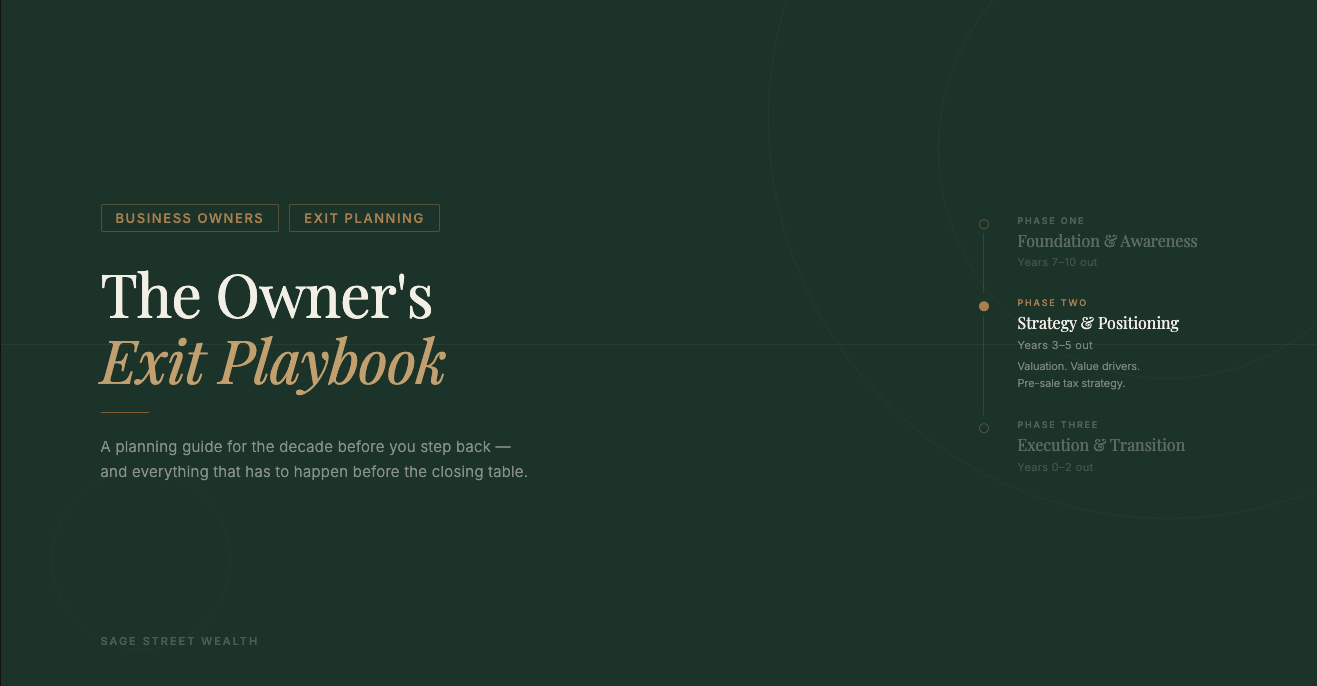
This is the most important phase of the entire process. The decisions made here have more financial impact on your exit outcome than anything that happens in the final year before the sale. Most owners don't realize this. They think the exit happens at the closing table. The exit is actually won or lost in the three to five years before closing.
At 3–5 years out, it's time to get a real number — not an estimate, not a back-of-napkin multiple. A formal valuation from a qualified business valuator.
Why now and not earlier? Because you need enough runway to actually do something with the information. A valuation at year one of a sale process is just a data point. A valuation at year four is a strategic tool — it tells you where you are, where the gaps are, and what it would take to move the number before you go to market.
Your concern about opening the books is valid. This engagement happens with a trusted, vetted professional under a confidentiality agreement, for a specific and bounded purpose. You know exactly what's being shared, with whom, and why.
Once there's a baseline valuation, the business is scored across the key factors that determine what a buyer will actually pay:
Owner dependency. Have you made progress since Phase One? Can the business operate without you for a meaningful period?
Revenue quality. How much of your revenue is recurring vs. one-time? Service contracts and maintenance agreements are valued significantly higher than project-based revenue.
Customer concentration. What percentage of revenue comes from your top three customers? If one customer represents 30% of revenue and has a personal relationship with you, a buyer will heavily discount the likelihood of retaining that revenue post-sale.
Financial clarity. Are your books clean, organized, and audit-ready? Messy financials are a massive red flag for buyers.
Management depth. Do you have people around you who stay post-sale?
Systems and processes. Is how you do things documented, or does it live in people's heads?
Each category is scored, the gaps are identified, and a prioritized improvement plan is built. A business that meaningfully improves its value driver profile over three years may command a significantly higher multiple at exit. That's real money.
This is where most business owners — and most advisors — leave significant money on the table.
The core insight: the best tax strategies available to you require time to implement. A strategy that could have saved you $300,000 in taxes at closing is worthless if you try to implement it 60 days before the sale. This work belongs in Phase Two precisely because you still have runway.
Charitable giving strategy. If you have any charitable intent — your church, a cause that matters to you, leaving something behind — there are structures that can dramatically reduce your capital gains tax at exit while also fulfilling that intent. A Charitable Remainder Trust funded with business interest before a sale can sell tax-free inside the trust, provide you an income stream for life, and pass the remainder to charity. A Donor-Advised Fund is simpler and more flexible. These are not obscure strategies — they're underutilized because most advisors don't raise them.
Gifting strategy. If you want to transfer some business value to your children, doing so now — while the business is worth less than it will be at exit — is significantly more tax-efficient than doing it at or after closing.
Entity structure for exit. Is the business in the right structure for an exit? A C-corp sale has very different tax treatment than an S-corp or LLC sale. If a structure change is warranted, it needs to happen years before the exit to avoid adverse tax treatment.
QSBS qualification. Qualified Small Business Stock under Section 1202 can exclude up to $15 million in capital gains from federal tax for qualifying C-corporation businesses. Many business owners and their advisors never check whether they qualify. Most small businesses structured as S-corps, LLCs, or partnerships do not qualify — but a strategic conversion years in advance may be worth exploring with your CPA and attorney.
By Phase Two you should be getting clear on which exit path you're actually pursuing. The path matters because it changes the preparation work significantly.
Sale to a child or family member. Requires a valuation for fairness, often involves seller financing or gifting of equity, and has enormous emotional complexity. The financial and family planning are inseparable here.
Sale to a key employee or partner. Often structured as a gradual buyout. Requires buy-sell agreement work, financing structure, and a transition plan that keeps the business stable during the handoff.
Sale to an outside buyer. A strategic buyer (a competitor or larger company) or a financial buyer (a private equity group or search fund). This path typically produces the highest purchase price but also the most process complexity.
ESOP. Selling to your employees through an Employee Stock Ownership Plan. Significant tax advantages, preserves the business culture, but complex and typically appropriate for businesses with at least 20–30 employees and strong management depth.
What Phase Two produces: A real valuation from a qualified professional. An annual value driver scorecard with year-over-year progress tracking. Pre-sale tax strategies identified and in motion. A clear succession path. And a personal financial foundation strong enough that you're not entirely dependent on a perfect exit outcome to be okay.
This is the most intense and emotional period of the entire process. The exit is no longer a planning exercise — it's happening. There are lawyers involved, there are buyers or successors at the table, there are offers and counteroffers and due diligence requests.
Most owners also experience something unexpected at this stage: profound ambivalence. The business they've spent decades building is about to belong to someone else. That's not just a financial event. It's an identity event.
When a letter of intent arrives, the price is the headline. The structure is where the real negotiation happens — and where unprepared owners get hurt.
Asset sale vs. stock sale. Buyers almost always prefer asset sales because they get a step-up in tax basis on the acquired assets. Sellers almost always prefer stock sales because proceeds are taxed at capital gains rates rather than ordinary income rates. The difference can be hundreds of thousands of dollars. This is a negotiating point, not a given.
Earnouts. A portion of the purchase price is paid after closing, contingent on the business hitting certain performance metrics. Common when there's a valuation gap between buyer and seller. They introduce risk — you're betting on a business you no longer control. Understanding when to accept an earnout, how to structure it, and what protections to insist on is critical.
Seller financing. You carry a note for a portion of the purchase price. This can produce better overall economics and has some tax advantages through installment sale treatment, but you carry counterparty risk if the buyer defaults.
Working capital adjustments. Most deals include a working capital target at closing. Owners who don't understand this mechanic often get surprised when the final number is different from the headline price.
At this stage you have a CPA, an estate attorney, an M&A attorney, an M&A advisor or business broker, and your financial advisor all working simultaneously on related but distinct pieces of the transaction. In most business sales these professionals never talk to each other. The owner ends up being the communication hub — getting advice from five directions, none of it coordinated.
Your financial advisor's role here is to be the integrating layer. The mistakes that happen in business sales almost always happen in the gaps between advisors.
The window is closing. Any strategies that weren't implemented in Phase Two need to be evaluated urgently — some will still be possible, some will be foreclosed by the timeline.
Specifically: charitable structures need to be established before a definitive purchase agreement is signed or the IRS will challenge the timing. Gifting of business interest to family members needs to happen before a deal is imminent. Your CPA and estate attorney need to be working in parallel with the transaction process, not sequentially after it.
Before the wire hits, you need a plan for what happens to the money — not after closing when the funds are sitting in a money market account and everyone has an opinion.
The plan should address how much liquidity you need immediately (taxes due, lifestyle, near-term spending), the long-term investment structure (how much risk, what asset allocation, what income the portfolio needs to generate), any remaining charitable moves to make with proceeds, and what the estate plan looks like for this wealth — it just changed dramatically in size and the documents need to reflect that.
This one gets skipped in almost every business sale process.
Most business owners have been working 50–60 hours a week for 20–30 years. The business has been their structure, their identity, their social world, their purpose. The Monday after closing is often the strangest day of their life.
The financial plan for life after exit is relatively straightforward. The personal plan is harder. What does your time look like? What gives you purpose? What does your marriage look like when you're both home? These aren't questions your financial advisor can answer for you. But a good advisor raises them — because the owners who think about life after exit before it happens transition significantly better than those who don't.
What Phase Three produces: A transaction that closes at or above your target number with a structure that maximizes after-tax proceeds. No last-minute surprises because the planning was done in advance. Proceeds with a home before the wire hits. An estate plan that reflects your new reality. And genuine clarity — emotionally and financially — about what comes next.
Most financial advisors meet business owners after the exit. They help manage the proceeds. That's valuable work — but it misses the years when the most important decisions are made, when the most expensive mistakes happen, and when the most meaningful value can be created.
There's also a harder truth most advisors never raise: not every exit is planned. Death, disability, a health crisis, a partner dispute, burnout — any of these can force a transition before you're ready. The owners whose families came through those moments intact — financially and emotionally — were the ones who had done the planning in advance.
The owners who exit well — who sell for what they need, structure the deal intelligently, protect their family throughout the process, and transition into the next chapter with financial confidence — are almost never the ones who figured it out alone. They're the ones who had someone in their corner years before the closing table.
If you're a business owner within a decade of a transition, the best time to start this process is now — not because the exit is imminent, but because the most valuable work happens in the years before it is. Schedule a discovery call here to talk through where you stand.