Most families pass down two things when wealth transfers across generations: assets and habits. The assets are planned for. The habits rarely are.
How your family talks about money, makes decisions together, and relates to generosity — those things transfer too, whether you intend them to or not. A family giving plan is how you make that transfer intentional.
It doesn't require a family foundation or a trust attorney. It doesn't require significant wealth. What it requires is a conversation — and a little structure to make that conversation productive.
Here's how to start.
What a Family Giving Plan Actually Is
A family giving plan is a shared framework for how your family approaches charitable giving. At its simplest, it answers three questions:
- What do we care about? The causes, communities, and values that matter to your family
- How much do we give? A commitment — expressed as a dollar amount, a percentage of income, or a percentage of assets
- How do we decide? A process for choosing where the money goes and who has a voice in that decision
That's it. It doesn't need to be a formal document or a legal structure. For many families, it starts as a dinner conversation. What matters is that it's intentional — that giving reflects a shared set of values rather than happening by accident.
Why This Matters More Than Most Families Realize
Generosity is one of the most powerful things you can model for the next generation. Studies on wealth transfer consistently show that children who are involved in giving decisions from an early age develop a fundamentally different relationship with money — one oriented around purpose rather than accumulation.
But involvement without structure can backfire. A teenager who gets to pick a charity once and never hears about it again doesn't develop a giving practice — they just fill out a form. The families who do this well create repeated touchpoints: annual conversations, shared decisions, follow-up on where the money went and what it did.
There's also a practical dimension. For families with meaningful assets, a giving plan creates alignment that prevents conflict later. Disagreements about charitable giving — who gets included, how much goes out, which causes are priorities — are a surprisingly common source of family tension around estate planning. A giving plan worked out while everyone is still at the table is far easier than one inherited without context.
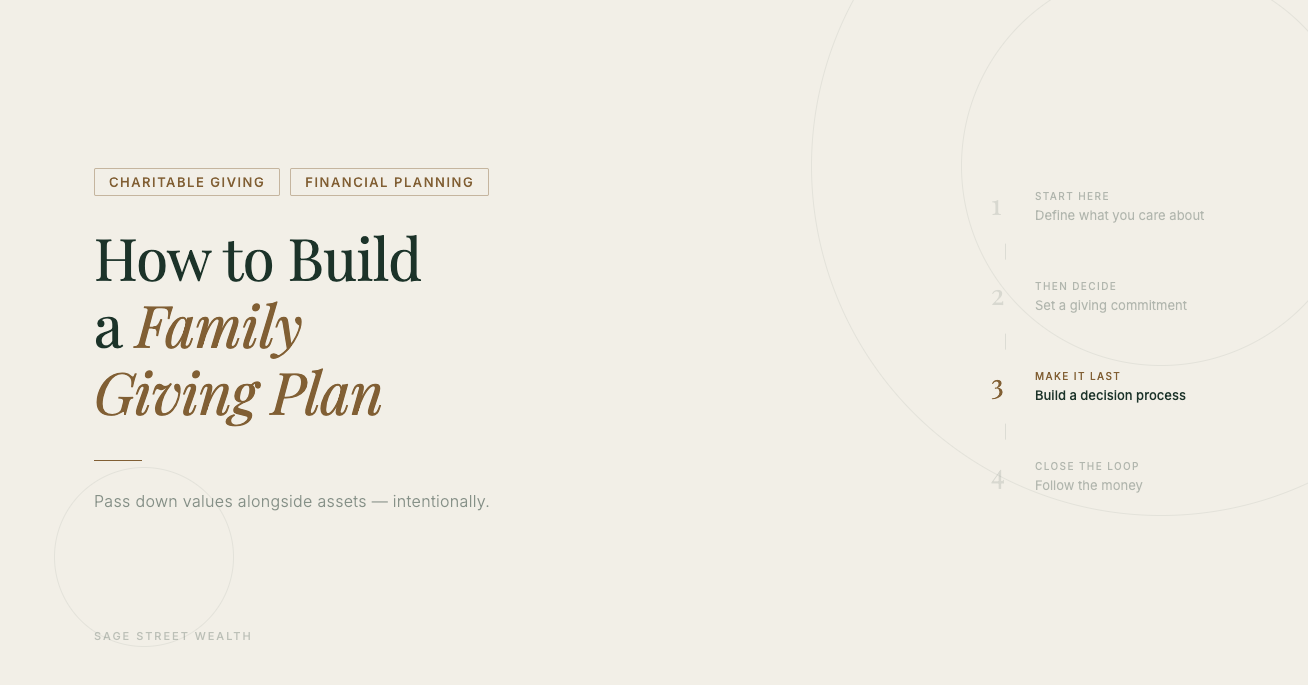
Step 1: Start With a Values Conversation
Before any dollars move, gather the family around the question: what do we care about?
Some families have an obvious answer — faith community, a cause connected to a family member's illness or experience, a deep tie to a particular place or institution. Others have to work for it. That's fine. The conversation itself is valuable.
A few questions that tend to open things up:
- What problems in the world feel most urgent to you personally?
- Is there a community — local, regional, or global — that has given something to our family?
- Are there causes we've supported for years without really thinking about why?
- What do we want our giving to say about who we are?
There are no right answers. The goal is to surface the values that are already present in your family and give them a name — so that future giving decisions have something to point back to.
Step 2: Set a Giving Commitment
Once you know what you care about, decide how much you're committing to give. Having a number — even a rough one — changes the nature of the conversation. It shifts giving from reactive to deliberate.
A few frameworks families use:
Percentage of income. Many families give a fixed percentage of their annual income — 5%, 10%, more. This approach scales with your circumstances and creates a consistent giving habit regardless of what any given year looks like.
Percentage of assets. For families with significant investable assets, committing to give a percentage of total wealth annually — often through a donor-advised fund — can create more meaningful impact than income-based giving alone.
Fixed annual amount. Simpler to track, but requires revisiting as income and assets change.
The specific number matters less than the commitment itself. A family that decides to give $10,000 per year and actually follows through will do more good — and build more generosity into the next generation — than one with vague intentions to give more when the time is right.
Step 3: Create a Decision Process
Who gets a voice? How are grants approved? What happens when family members disagree?
For smaller families with simple giving, the process can be informal — an annual conversation where everyone weighs in and decisions are made by consensus. For larger families or more significant giving, a bit more structure helps.
A donor-advised fund is the most practical tool for implementing a family giving plan. It holds the assets, keeps the records, and allows multiple family members to be involved in grant recommendations — without requiring the complexity of a private foundation. You can name the fund after your family, add children or grandchildren as successors, and involve them in the grantmaking process over time.
A few things worth deciding upfront:
- Frequency. Do you make grants once a year as a family, or on a rolling basis?
- Minimum grant size. Having a floor — say, $500 per grant — reduces administrative friction and encourages more thoughtful decisions.
- Focus areas vs. open giving. Some families designate a percentage for focus areas (causes they've committed to long-term) and leave the rest open for spontaneous giving. This creates structure without rigidity.
- Youth involvement. If children are old enough, giving them a small portion of the family grant budget to allocate themselves is one of the most effective ways to build generosity as a practice.
Step 4: Follow the Money
One of the most overlooked elements of family giving is closing the loop. When a grant goes out, what happened? Did the organization do what it said it would? What did your family's gift make possible?
This doesn't require a formal evaluation process. It can be as simple as a letter from the nonprofit, a site visit, or a five-minute update at your next family giving conversation. The point is to connect the decision to the outcome — to make giving feel real rather than transactional.
Families who follow their giving tend to give more purposefully over time. And children who see the impact of generosity are far more likely to carry it forward.
How a Financial Advisor Fits In
A family giving plan lives at the intersection of values and financial planning. An advisor's role isn't to tell you what to care about — it's to make sure the giving you're already committed to is structured as efficiently as possible.
That means thinking about which assets to give and when, how giving fits into your broader tax picture, how a donor-advised fund can serve as the vehicle for a multigenerational plan, and how charitable giving integrates with your estate plan so your values transfer alongside your assets.
At Sage Street Wealth, this is where we spend a lot of our time. The families we work with don't want generosity to be an afterthought. They want it built into the plan — as intentionally as everything else.
Evan Hammond is the founder of Sage Street Wealth, a fee-based fiduciary wealth management firm in Reno, Nevada, specializing in financial planning for families with charitable intent.
If you'd like to talk through what a giving plan could look like for your family, schedule a discovery call here — no obligation, no pitch. Just a conversation.